Published by Sherwoods Property | sherwoodsproperty.com | June 2026
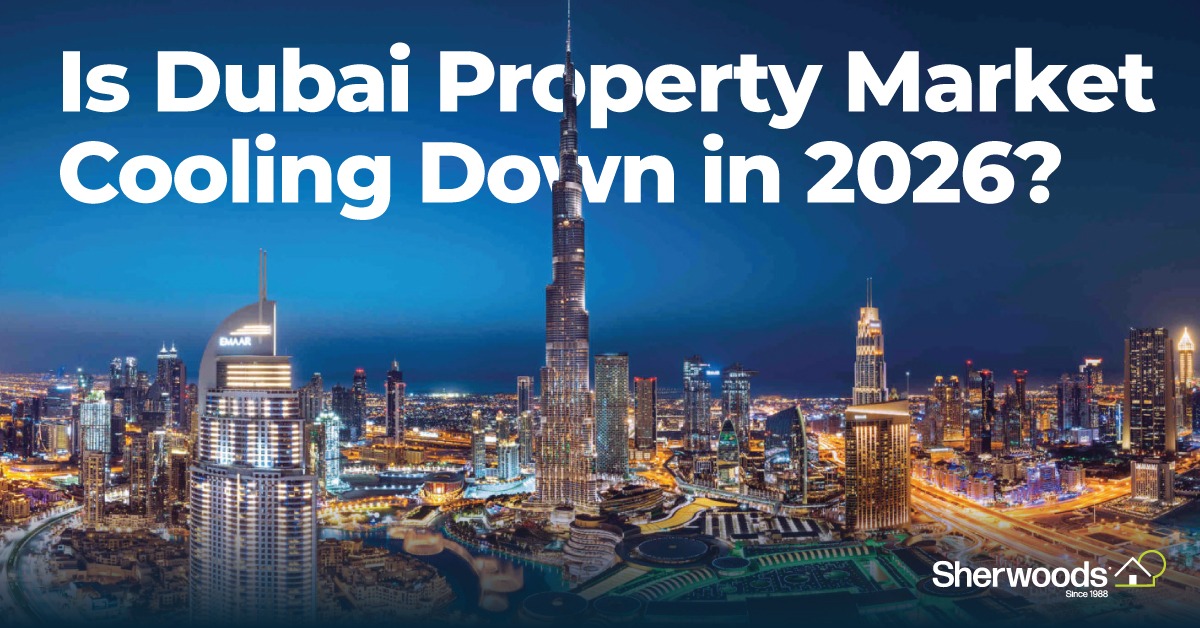
A question is spreading among buyers, investors, and Google searches right now: is the Dubai property market cooling down in 2026? After years of strong growth, a brief dip in confidence during the first quarter raised eyebrows. Headlines followed quickly. Some buyers rushed in. Others paused entirely.
The short answer is no. The market is not cooling. Instead, it is taking a breath after a record-breaking run. Historically, this kind of pause has come before Dubai’s next growth phase. This article looks at the real numbers, explains what caused the short-term softness, and sets out the case for why long-term prices are heading in one direction only.
What the Numbers Actually Show for 2026
Before forming a view, it helps to start with the data. Here is what the Dubai Land Department (DLD) and leading research firms report for the period up to June 2026.
Transaction Volumes Remain Historically Strong
- January 2026 was the strongest single month in Dubai property history. It recorded AED 72.4 billion in total transaction value — a 63% rise year-on-year, according to Property Finder.
- Q1 2026 recorded 45,221 home sales worth AED 137.31 billion, up 19% in value year-on-year, according to DLD and Reidin data.
- Total Q1 sales including commercial reached AED 176.7 billion across nearly 48,000 deals. Value growth was 23.4% year-on-year (fäm Properties).
- February 2026 also held firm, with transaction value up 19% year-on-year.
Prices Are Rising, Not Falling
- The average price per square foot stood at AED 1,976 in January 2026. That is up 18% year-on-year from AED 1,674 in January 2025 (DXB Analytics / DLD).
- Off-plan apartment prices averaged AED 2,030 per sq ft in Q1 2026, up 12.22% year-on-year (ValuStrat).
- Ready apartment prices reached AED 1,871 per sq ft, up 8.5% year-on-year (Reliant Surveyors).
- Villa prices hit AED 2,376 per sq ft, up 12.5% year-on-year.
- The median sale price in early 2026 sits at AED 1,745,000 — up 14% year-on-year (DXBInteract).
Rental Yields Remain World-Class
- Apartment gross rental yields held at 7.10% in Q1 2026. That is among the highest of any major global property market.
- Studios and one-bedroom apartments in high-demand areas are generating 6–9% gross yields.
- Villa yields are at 4.57%. However, this drop is caused by capital values growing faster than rents — which is a sign of a strong market, not a weak one.
Sherwoods Verdict: A market with 18% year-on-year price growth, AED 176.7 billion in quarterly sales, and apartment yields of 7.1% is not cooling. It is performing.
So What Caused the Q1 Slowdown? Three Short-Term Factors
If the data is so strong, why does the “cooling” story exist at all? Three specific and short-term factors came together in Q1 2026. As a result, transaction volumes — not prices — softened briefly. Some people mistook this for a lasting shift. It was not.
1. Regional Conflict Dented Buyer Confidence in March
The rise in Iran-Israel tensions in late February and March 2026 was a real shock to buyer confidence across the UAE. New enquiries slowed. Some deals were delayed. Savills and Cavendish Maxwell both linked the weaker March performance to this tension. They noted it reflected a change in mood, not a change in Dubai’s core strengths.
For example, the DFM Real Estate Index — which tracks listed developer stocks — fell around 20% in the days after the escalation. In contrast, physical property prices only dipped 4–7% from their February peak at the worst point. That gap is important. It tells you that market mood shifted, not market value.
2. Ramadan and Eid al-Fitr Created Seasonal Quietness
Ramadan and Eid al-Fitr fell in March and April 2026. Consequently, this period slowed transaction volumes across the UAE. Working patterns change, travel increases, and decisions take longer. Furthermore, this seasonal pattern repeats every year. It is a calendar event, not a warning sign. Cavendish Maxwell noted that the combination of Ramadan and regional tension made March especially quiet — a one-off overlap, not a trend.
3. Q4 2025 Was an Exceptionally High Starting Point
Dubai’s property market topped 50,000 transactions in each of the final three quarters of 2025 — an all-time record. Therefore, when Q1 2026 came in at 45,221 deals, the 17.1% quarterly drop looked alarming without context. However, that context matters: Q1 2026 still ranks as one of the strongest first quarters in Dubai’s history. In other words, a market running slightly below its own record pace is still outperforming almost every other property market in the world.
Key point: All three of these factors are short-term. Regional tensions are easing following the June 19 Iran-US agreement. Ramadan is over. The comparison base also returns to normal from Q2 2026 onward. None of them change the long-term growth story for Dubai property.
The Real Story: What Is Driving Dubai Property Prices Higher Long-Term
The short-term Q1 softness is the wrong thing to focus on. Instead, the right thing to focus on is the scale of building work Dubai is carrying out over the next decade. Infrastructure is the single most reliable driver of property price growth in any city.
The Al Maktoum International Airport Expansion: The Biggest Growth Engine in Dubai’s History
The expansion of Al Maktoum International Airport (DWC) is the largest single project in Dubai’s history. In addition, it is one of the most significant property catalysts on earth right now. Here is what it involves:
- $35 billion Phase 1 budget, targeting 150 million passengers annually by 2032.
- Five parallel runways and 400 aircraft gates at full build-out — making it the world’s largest airport by passenger capacity at 260 million annually.
- Phase 1 construction is underway — early 2026 saw major bids from China State Construction, Dutco, Webuild, Vinci, and Limak Holding.
- Emirates Airlines will move entirely from Dubai International Airport to DWC. CEO Paul Griffiths called it “the largest airline transition in history.”
- Over 1 million jobs in aviation, logistics, hospitality, and cargo are projected to be created by the airport ecosystem.
- 25–30% of Dubai’s GDP is expected to flow through the airport by 2030.
- Warehouse space near the Jebel Ali Port–Al Maktoum corridor is already at 98% occupancy. Industrial demand is running ahead of the airport’s opening.
Furthermore, the property impact is already visible. Rents in Dubai Investment Park and Dubai South have risen 20% in the past 12 months. This is largely because Emirates staff are starting to move ahead of the full transition. As a result, early investors in the Dubai South corridor are entering at prices well below what they will be at completion. Dubai South properties today are 40–60% below central Dubai averages — with all the main growth drivers still ahead of them.
Dubai Metro Expansion: Blue Line, Gold Line, and the Airport Express
Dubai is not just building an airport. It is also building the transport network to make that airport, and dozens of nearby communities, far more accessible. The current metro expansion is the biggest step forward in connectivity since the original Red Line opened in 2009.
- Blue Line (AED 18 billion, 14 stations, 30 km) — approved by Sheikh Mohammed bin Rashid Al Maktoum, now at 10% completion, opening in 2029. It connects Dubai Creek Harbour, Dubai Festival City, Dubai Silicon Oasis, and Mirdif — areas that have historically been cheaper due to poor transport links.
- Gold Line (AED 34 billion, 18 stations, 42 km) — announced April 22, 2026, opening September 9, 2032. It runs from Al Ghubaiba to Jumeirah Golf Estates, with stops at Nad Al Sheba, Dubai Hills, and the Meydan Racecourse area.
- Airport Express Line — the RTA is currently seeking bids to design a 55 km metro link connecting Dubai International Airport directly to Al Maktoum International Airport, with five stations and built-in check-in facilities.
- By 2030, Dubai Metro will cover 64 stations and 84 square kilometres. By 2040, the plan extends to 140 stations and 228 square kilometres.
The historical evidence from Dubai itself is clear. When the Red Line opened in 2009, properties within 500 metres of stations saw a 12% price premium emerge within two years. JLT, previously seen as too far out, became one of Dubai’s most popular areas almost overnight. As a result, the Blue and Gold Lines are setting up the same effect for a new set of communities.
Etihad Rail: Dubai Connected to the Whole UAE and Beyond
The Etihad Rail passenger service is set to launch later in 2026. The first Dubai station will be at Jumeirah Golf Estates. Moreover, a dedicated station at Al Maktoum International Airport will link the airport to the UAE’s national rail network — connecting Dubai to Abu Dhabi, Sharjah, Fujairah, and eventually to Saudi Arabia and Oman.
For property investors, this means Dubai South and the southern corridor will no longer be a single-city play. Instead, they will become the meeting point of international aviation, national rail, and local metro — a multi-mode hub on a scale the region has not seen before.
Palm Jebel Ali, Dubai Islands, and the New Waterfront Map
Infrastructure investment is not limited to transport. In addition, entire new waterfront areas are being developed.
- Palm Jebel Ali — the relaunched mega project sits directly next to the Al Maktoum Airport corridor and the Jebel Ali Port, combining waterfront living with logistics-hub access.
- Dubai Islands — five man-made islands off Deira, adding a new northern waterfront district to Dubai’s premium living map.
- Marasi Business Bay — a planned waterfront mixed-use district that will reposition Business Bay’s eastern edge.
Each of these projects lifts demand in its surrounding area. Taken together, they are redrawing Dubai’s premium property map beyond its old limits — creating new high-value zones where supply is tight and demand is growing fast.
UAE D33 Economic Agenda: The Government Plan Behind the Growth
None of this is happening by chance. The UAE’s D33 Economic Agenda sets a clear target of doubling Dubai’s economy by 2033. That means adding AED 800 billion to the city’s output over a decade. The parts of D33 that most directly support property prices include:
- Attracting 100 new multinational headquarters to Dubai.
- Reaching AED 25 billion in annual foreign direct investment.
- Growing Dubai’s population to 5.8 million by 2040 (from around 3.6 million today).
- Placing Dubai among the top 3 global financial centres.
- UAE GDP growth forecast at 5.6% for 2026 — the strongest rate among GCC countries and well above the global average (IMF).
Population growth is the most direct driver of housing demand. Dubai’s resident base is growing every year. This is driven by professionals, business owners, and families moving from higher-tax, more restricted places. Consequently, that flow does not pause because of one quarter of global tension. It is a long-term trend, and it is the foundation under Dubai’s property market.
What the Experts Are Forecasting for the Rest of 2026 and Beyond
Leading research firms are not predicting a crash. Instead, they are forecasting a measured, healthy slowdown from the rapid pace of 2024–2025. That is exactly what a sustainable market should do.
- Cushman & Wakefield Core forecast price growth slowing to 5–8% across 2026. This is a step down from the 12–22% annual gains seen in 2024–2025, but still well above most global markets.
- Knight Frank expects prime segment growth of around 3%, with mainstream markets averaging roughly 1% by year-end — a floor, not a ceiling.
- Savills expects off-plan volumes to ease in Q2 2026 before recovering, while noting that underlying demand stays positive.
- Property Finder reports that villa searches reached 46% of all sale searches in April 2026 — the highest of the year. Moreover, mortgage activity hit its peak at AED 9.02 billion, showing a strong April rebound.
- Dubai South properties are forecast to appreciate 25–40% by 2032 as Al Maktoum Airport Phase 1 is delivered (Real Estate Club Dubai).
“Every market faces moments of hesitation — what matters is what the data shows when that hesitation lifts. Those who paused in March were making a timing decision, not a fundamentals-based one.” — Cherif Sleiman, Chief Revenue Officer, Property Finder
Frequently Asked Questions: Dubai Property Market 2026
Is the Dubai property market going to crash in 2026?
No credible research firm is forecasting a crash. Prices rose 18% year-on-year in January 2026 and remain well above 2024 levels. The short-term Q1 slowdown was caused by regional tension and Ramadan — not by oversupply, job losses, or weak demand at the structural level.
Are Dubai property prices falling in 2026?
No. Average prices per square foot are up 18% year-on-year as of January 2026. Across apartments and villas, Q1 2026 showed gains of 8.5–12.5%. A modest 4–7% dip from the February peak occurred at the worst point of the regional tension. However, prices have since stabilised and recovered.
Is it a good time to buy property in Dubai in 2026?
For investors with a 3–10 year view, yes. The key growth drivers are all still in place: Al Maktoum Airport, the Blue and Gold Line Metro, Etihad Rail, Palm Jebel Ali, population growth, and the D33 economic plan. Furthermore, Dubai’s core strengths — zero income tax, freehold ownership, and a strong legal framework — are fully intact.
Which areas of Dubai offer the best property investment in 2026?
Areas linked to new infrastructure offer the strongest long-term case. Dubai South and the Al Maktoum Airport corridor lead on capital growth. Downtown Dubai and Business Bay offer yield and stability. Dubai Creek Harbour and Dubai Hills Estate work well for lifestyle buyers. In addition, emerging Blue Line metro areas such as Dubai Silicon Oasis and Mirdif offer value for growth-focused investors.
Are Dubai rental yields still strong in 2026?
Yes. Apartment gross yields averaged 7.10% in Q1 2026. That is well above comparable markets in London, Singapore, New York, or Paris. Studios and one-bedroom flats in high-demand areas such as JVC, Business Bay, and Dubai Marina are generating 6–9% gross yields.
How does the Al Maktoum Airport expansion affect Dubai property prices?
It is the single most important long-term growth driver in Dubai’s pipeline. The $35 billion Phase 1 project is expected to create over 1 million jobs and produce 25–30% of Dubai’s GDP by 2030. Properties in the surrounding Dubai South area are currently priced 40–60% below central Dubai — well below where similar airport-hub areas in other global cities trade.
What is the Dubai property price forecast for 2027 and beyond?
Most forecasters see 5–8% annual price growth through 2026. After that, growth is expected to pick up again as major milestones are reached — the Blue Line Metro in 2029 and Al Maktoum Phase 1 in 2032. Dubai South properties in particular are forecast to rise 25–40% by 2032.
The Bottom Line: A Pause Is Not the Same as a Peak
Dubai’s property market paused in Q1 2026. However, it did not peak. That difference matters a great deal for investors trying to make clear-headed decisions in the face of short-term news.
The core strengths have not changed. Population is growing. The government is spending at a record pace. New infrastructure is being built that will make Dubai more connected, more productive, and more in demand than at any point in its history. Furthermore, rental yields are among the best in the world. And prices, even after a brief dip, are still 14–18% above where they were twelve months ago.
Therefore, the investors who will look back on 2026 with satisfaction are those who looked past the quarterly headlines. They focused instead on the decade-long story: a city of 3.6 million growing into a city of 5.8 million, anchored by the world’s largest airport, served by four metro lines, and backed by a government with both the ambition and the money to make it happen.
In short, the Dubai property market is not cooling down. It is loading up for the next chapter.
Ready to Invest? Talk to Sherwoods Property
Our team of specialists helps buyers and investors navigate Dubai’s property market with clarity, data, and genuine expertise. Whether you are buying your first property in Dubai or expanding an existing portfolio, we are here to help you make the right move at the right time.
Sherwoods Property is a leading UAE real estate consultancy. Data cited in this article is sourced from Dubai Land Department (DLD), DXB Analytics as published and reported through June 2026. This article is for informational purposes only and does not constitute financial or investment advice. Always seek independent professional advice before making a property purchase decision.
