
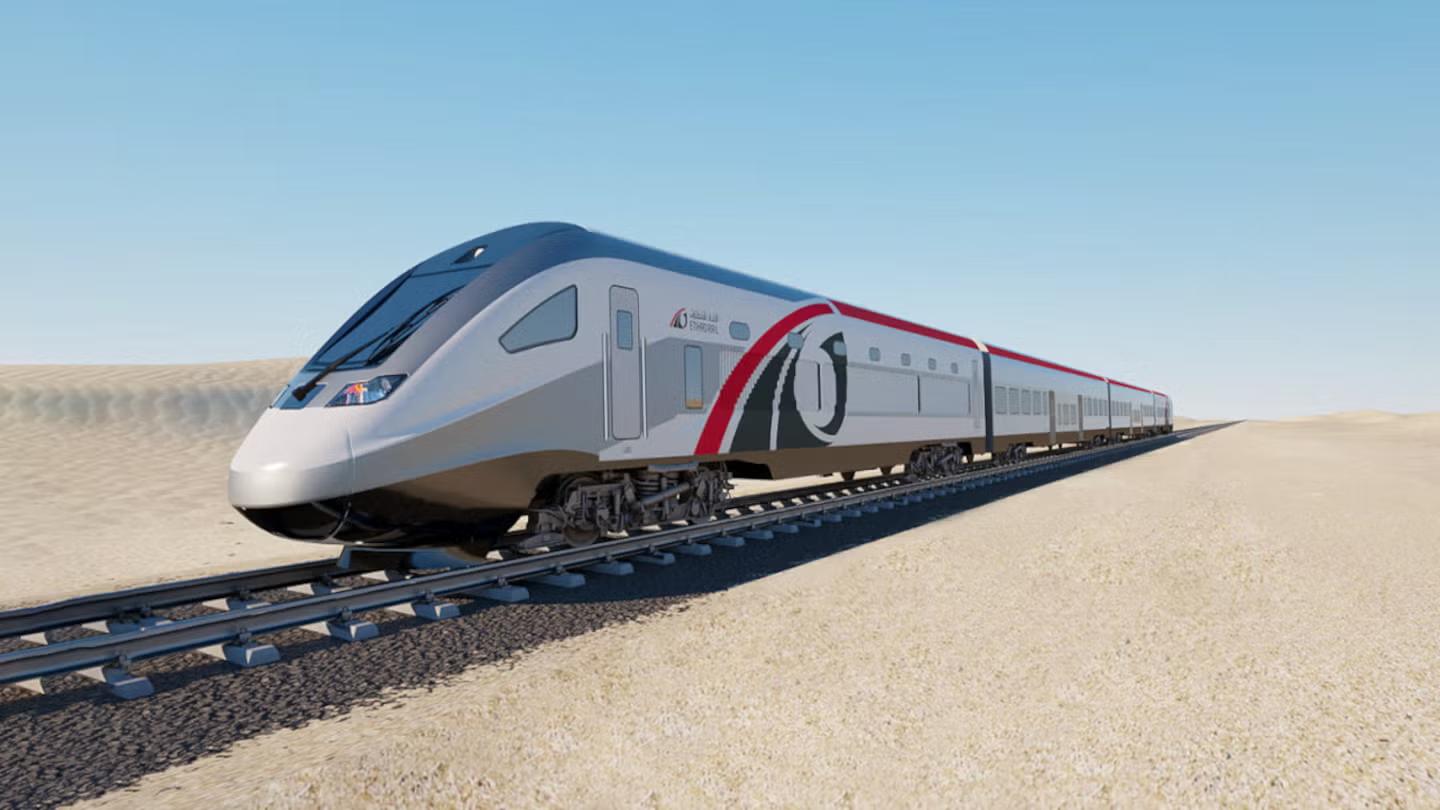
Today, June 30, 2026, the UAE crosses a milestone it has been building toward for over a decade. Etihad Rail’s passenger service officially opens, connecting Abu Dhabi’s Mohammed bin Zayed City station with Al Hilal City in Fujairah for the very first time. For residents, the journey that once took over two hours by road now takes 1 hour and 45 minutes by train. For investors, it marks the moment a 900-kilometre national rail network begins reshaping the UAE’s property map in real time.
Every outlet will tell you it launched today. This article tells you what it actually means — for travellers, for businesses, for residents in the Northern Emirates, and most importantly, for the communities and property markets that sit along its route.
What Is Etihad Rail and Why Does It Matter?
Etihad Rail is the UAE’s national railway operator, established in 2009 to build and run a rail network linking all seven emirates. Since 2016, the system has operated a freight service carrying sulphur, aggregate, and industrial goods between Abu Dhabi, Dubai, and Fujairah. However, the passenger service that launches today is something entirely different in scale and significance.
At full build-out, the network will span 900 kilometres, connecting 11 cities and locations across the UAE — from Al Sila on the Saudi border in the west to Fujairah on the east coast. Moreover, it targets 36.5 million passengers annually by 2030. To put that in context, Heathrow Airport handles around 80 million passengers per year. In other words, Etihad Rail is planning for nearly half that throughput — in a country with a population of 10 million people.
Day-to-day operations run through Etihad Rail Passenger Services, a joint venture between Etihad Rail and Keolis — one of the world’s leading public transport operators, which also manages rail networks in France, the UK, Australia, and Singapore. Additionally, trains are built by CAF (Construcciones y Auxiliar de Ferrocarriles), the Spanish rolling stock manufacturer, and travel at speeds of up to 200 km/h.
The Full Station and Route Rollout: Every Date You Need
Etihad Rail is opening in four carefully staged phases through to March 2027. Here is the complete timeline:
Phase 1: June 30, 2026 — Abu Dhabi to Fujairah (Live Today)
- Abu Dhabi Station: Mohammed bin Zayed City Passenger Train Station — inaugurated by Sheikh Khalid bin Mohammed bin Zayed Al Nahyan, Crown Prince of Abu Dhabi
- Fujairah Station: Al Hilal City — the first completed station in the entire network
- Journey time: 1 hour and 45 minutes
- Fares: From AED 55 (Comfort Class) and AED 120 (Premium Class)
- Ticket booking: Available via the Etihad Rail app and website since June 23, 2026
Phase 2: September 30, 2026 — Official Network Launch Including Dubai
- Dubai Station: Jumeirah Golf Estates — strategically connecting to the future Gold Line Metro and existing road network
- Al Dhaid Station: Sharjah — one of the most significant stations for commuter flow from the Northern Emirates
- Abu Dhabi to Dubai journey time: 57 minutes
- Dubai to Fujairah journey time: 1 hour and 9 minutes
- RTA is deploying feeder buses and taxis from the Jumeirah Golf Estates station to support last-mile connectivity across Dubai
Phase 3: December 30, 2026 — Al Dhafra Region Opens
- Stations in Abu Dhabi’s Al Dhafra region begin operations, including Al Dhannah, Al Mirfa, Madinat Zayed, Mezairaa, and Al Sila
- This phase connects the far western Abu Dhabi corridor — including Ruwais — to the national network, with a journey time from Abu Dhabi to Al Ruwais of 1 hour and 10 minutes
Phase 4: March 30, 2027 — Sharjah Station Completes the Network
- Sharjah University City Station opens, completing the initial passenger network
- At this point, the full 11-city, multi-emirate passenger rail network is operational from Al Sila in the west to Fujairah in the east
Complete Journey Times Across the Etihad Rail Network
| Route | Journey Time by Train | Typical Road Time | Time Saved |
|---|---|---|---|
| Abu Dhabi → Fujairah | 1 hr 45 min | 2 hr 15–30 min | 30–45 min |
| Abu Dhabi → Dubai | 57 min | 1 hr 30–2 hr | 33–63 min |
| Dubai → Fujairah | 1 hr 9 min | 1 hr 30–2 hr | 21–51 min |
| Abu Dhabi → Al Ruwais | 1 hr 10 min | 2 hr+ | 50+ min |
| Abu Dhabi → Al Dhaid | Approx 2 hr | 2 hr 30+ min | 30+ min |
Etihad Rail estimates that journey times will reduce by 30 to 40 percent compared to other modes of transport across all routes. Moreover, train travel eliminates the unpredictability of road traffic — a factor that significantly understates the practical time saving for daily commuters.
What the Trains Are Actually Like: On-Board Experience
Etihad Rail runs a fleet of 13 CAF passenger trains, each carrying up to 400 passengers across three cabin classes.
Cabin Classes
- Comfort Class — the standard travel option, from AED 55 on the Abu Dhabi–Fujairah route
- Premium Class — upgraded seating and amenities, from AED 120 on the Abu Dhabi–Fujairah route
- Family Class — a dedicated family cabin for travelling groups with children
On-Board Amenities
- Infotainment systems at every seat
- Charging stations throughout all cabins
- Food and beverage service
- Generous legroom across all classes
- Advanced air-conditioning designed for Gulf climate conditions
- High levels of security and surveillance throughout the train
Station Amenities (Fujairah, confirmed open today)
- Cafés, restaurants, and retail outlets
- Ticketing machines and digital kiosks
- Car parking facilities
- Car rental services
- Taxi rank for immediate onward travel
- Dedicated waiting areas
How to Book
Tickets are available through the Etihad Rail mobile app and the official Etihad Rail website. Booking has been live since June 23, 2026. Passengers can modify or cancel reservations through the same platform. Additionally, Dubai’s RTA is the official ticketing and payment partner for Etihad Rail, which means the nol card — already used across Dubai Metro and buses — is expected to become a valid payment method for Etihad Rail journeys.
What About the High-Speed Abu Dhabi–Dubai Rail Line?
Today’s service travels at up to 200 km/h. However, a separate and even more transformative project is already in development: a dedicated high-speed rail line between Abu Dhabi and Dubai, capable of speeds up to 350 km/h, cutting the journey between the two cities to just 30 minutes.
Crucially, this is not the same as the standard Etihad Rail passenger route. Rather, it is a separate, higher-speed corridor in planning, with an expected operational date of 2030. When it opens, the concept of choosing between Abu Dhabi and Dubai as a place to live or work becomes almost irrelevant. In effect, a 30-minute rail journey merges the two cities into a single commutable metropolitan area — with profound implications for property markets along the entire corridor.
What Etihad Rail Means for UAE Property Markets: The Investment Case
Transport infrastructure is the single most reliable predictor of property price appreciation in any city or region. Indeed, the evidence from Dubai’s own Metro history is unambiguous. When the Red Line opened in 2009, properties within 500 metres of stations appreciated an average of 12% within two years. As a result, JLT — previously dismissed as too peripheral — became one of Dubai’s most desirable residential corridors almost overnight. Today, the same dynamic is playing out across the Etihad Rail network, on a far larger geographic scale.
Fujairah: The Northern Emirates Enter a New Era
Fujairah has long offered some of the UAE’s most affordable residential property alongside genuine coastal lifestyle credentials — beaches, mountains, and a quieter pace of life that many UAE residents actively want. However, its distance from Abu Dhabi and Dubai made it a lifestyle choice that came with a real career compromise. Etihad Rail ends that compromise entirely.
- Residents can now commute to Dubai in 1 hour and 9 minutes by train — faster than many intra-city commutes in London or Sydney
- Reaching Abu Dhabi takes just 1 hour and 45 minutes — shorter than the road journey from Abu Dhabi’s outskirts to its city centre on a busy day
- Fujairah property prices currently average 40–60% below comparable Dubai coastal properties — for beachfront living with mountain backdrops and far lower population density
- The emirate’s port — one of the largest bunkering hubs in the world — creates a strong professional employment base that rail access now opens to the wider UAE workforce
For property investors, Fujairah in June 2026 has the same profile that Ras Al Khaimah had five years ago: overlooked, underpriced, and sitting directly in the path of an infrastructure catalyst that will close the gap with its better-known neighbours.
Al Dhaid and the Sharjah Corridor: The Affordable Belt Gets Accessible
Al Dhaid in Sharjah is one of the UAE’s most affordable residential markets. Over recent years, it has attracted residents priced out of Dubai and Sharjah city, but its distance from employment centres limited its appeal to those without cars. However, the September 30 station opening changes that calculation fundamentally. Rail access to Dubai and Abu Dhabi makes Al Dhaid a genuinely viable long-term community for a much broader income range. Moreover, when affordable communities gain rail connectivity, rental demand and property values typically follow within 12–24 months of opening.
Jumeirah Golf Estates and the Dubai Station Effect
The Dubai Etihad Rail station at Jumeirah Golf Estates opens September 30. This single station carries two immediate implications. First, it connects southern Dubai directly to the national rail network, making the surrounding corridor immediately more accessible to Abu Dhabi and Northern Emirates commuters. Second, a confirmed map of Dubai’s 2032 rail network shows this station connecting with both the existing Red Line and the upcoming Gold Line Metro — creating a true multi-modal interchange at a location currently seen as peripheral. In short, properties in that corridor are still pricing before that connectivity is fully understood by the market.
Al Maktoum International Airport: The Next Etihad Rail Station
Dubai Airports leadership has strongly hinted that Al Maktoum International Airport — the $35 billion expansion project set to become the world’s largest airport — will eventually receive an Etihad Rail station upon completion of the airport’s main build-out. If confirmed, this would create a direct rail link between Abu Dhabi city centre, Dubai’s new mega-airport, Sharjah, and Fujairah on a single national network. The investment implications for the Dubai South property corridor — already driven by airport expansion — would be substantial.
Etihad Rail and the Northern Emirates: A Region Transformed
The Northern Emirates — Fujairah, Ras Al Khaimah, Umm Al Quwain, Ajman, and the Sharjah enclaves — have historically offered the UAE’s lowest property prices alongside some of its most dramatic natural settings. Their weakness, however, has always been connectivity: without a car, reaching Dubai or Abu Dhabi for work was simply impractical. Today, Etihad Rail begins dismantling that barrier.
Fujairah gains direct rail access to the national network from today. Sharjah follows in September and March 2027. Furthermore, a feasibility study is currently underway to evaluate extending services to additional emirates — including Ras Al Khaimah and Umm Al Quwain. If that expansion proceeds, the Northern Emirates will shift from being affordable alternatives to being genuinely rail-connected commuter regions. Historically, that shift drives significant property value appreciation within 2–3 years of opening.
The Ruler of Fujairah, HH Sheikh Hamad bin Mohammed Al Sharqi, made his position clear at the station inauguration: the rail connection will open new opportunities for the emirate by strengthening trade, enhancing connectivity, and improving quality of life. Therefore, this is not ceremonial language — it is a statement of economic direction backed by infrastructure that is now operational.
Frequently Asked Questions: Etihad Rail Passenger Service 2026
When does Etihad Rail passenger service start?
The introductory passenger service between Abu Dhabi and Fujairah begins today, June 30, 2026. The official full network launch, including Dubai and Al Dhaid stations, takes place on September 30, 2026.
What is the ticket price for Etihad Rail?
On the Abu Dhabi–Fujairah route, fares start at AED 55 for Comfort Class and AED 120 for Premium Class. Ticket prices for the Dubai route and other stations will be announced closer to the September 30 launch.
How long does the Abu Dhabi to Fujairah train take?
The journey takes 1 hour and 45 minutes — compared to over 2 hours by road. The train travels at speeds of up to 200 km/h.
How long does the Abu Dhabi to Dubai train take?
The Abu Dhabi to Dubai journey on Etihad Rail takes 57 minutes. The Dubai station at Jumeirah Golf Estates opens on September 30, 2026.
How do I book Etihad Rail tickets?
Tickets are available through the Etihad Rail mobile app and official website. Booking has been live since June 23, 2026. Dubai’s nol card is expected to become a valid payment method for the service.
Where is the Etihad Rail Dubai station?
The Dubai station is located at Jumeirah Golf Estates, in the southern part of the city. It opens on September 30, 2026, and will eventually connect to both the Red Line and the upcoming Gold Line Metro, creating a multi-modal interchange.
Will Etihad Rail connect to Al Maktoum International Airport?
Dubai Airports leadership has strongly indicated that Al Maktoum International Airport will eventually receive an Etihad Rail station as part of the airport’s long-term expansion. No confirmed date has been announced yet.
What is the high-speed rail between Abu Dhabi and Dubai?
A separate high-speed rail project under development will connect Abu Dhabi and Dubai at speeds of up to 350 km/h, reducing the journey to 30 minutes. This is distinct from the standard Etihad Rail passenger service and is expected to be operational by 2030.
How does Etihad Rail affect property prices?
Rail connectivity has historically driven 12–25% price appreciation in communities that gain new train access. Fujairah, Al Dhaid, and the Jumeirah Golf Estates corridor in Dubai are the three areas Sherwoods Property expects to see the most significant repricing as the Etihad Rail network expands through 2026 and 2027.
Which emirates does Etihad Rail connect?
The initial network connects Abu Dhabi, Dubai, Sharjah, and Fujairah. When fully operational in March 2027, 11 cities and locations will be linked from Al Sila in the west to Fujairah in the east. A feasibility study is underway to extend services to Ras Al Khaimah and other Northern Emirates.
The Bottom Line: What Launches Today Is Bigger Than a Train
What begins today is not just a rail service. Instead, it is the physical realisation of a vision the UAE announced as one of its Fifty Projects in 2021 — and it arrives less than five years later, on time, fully operational, and immediately impactful.
Residents gain a UAE where choosing where to live is no longer dominated by commute anxiety. Fujairah’s coastline, Sharjah’s affordability, and Abu Dhabi’s employment base all become simultaneously accessible from a single home address. That is a transformation in daily quality of life that no amount of road widening could have achieved.
Investors, meanwhile, gain access to a repricing cycle in communities that previously sat outside Dubai and Abu Dhabi’s property premium. Fujairah is the most immediate beneficiary today. Al Dhaid and the Sharjah corridor follow in September. Moreover, the Dubai station effect arrives from September 30 onward. By the time the high-speed Abu Dhabi–Dubai line opens in 2030, the entire property map of the UAE corridor between these two cities will look fundamentally different from today.
The investors who will look back on 2026 with the most satisfaction are the ones who recognised that Etihad Rail was not a transport story. It was a property story — and today is the day it begins.
If you want to understand how today’s launch affects the value of property you own, or the opportunity in property you are considering buying, the Sherwoods Property team is ready to help you navigate this new map.
