
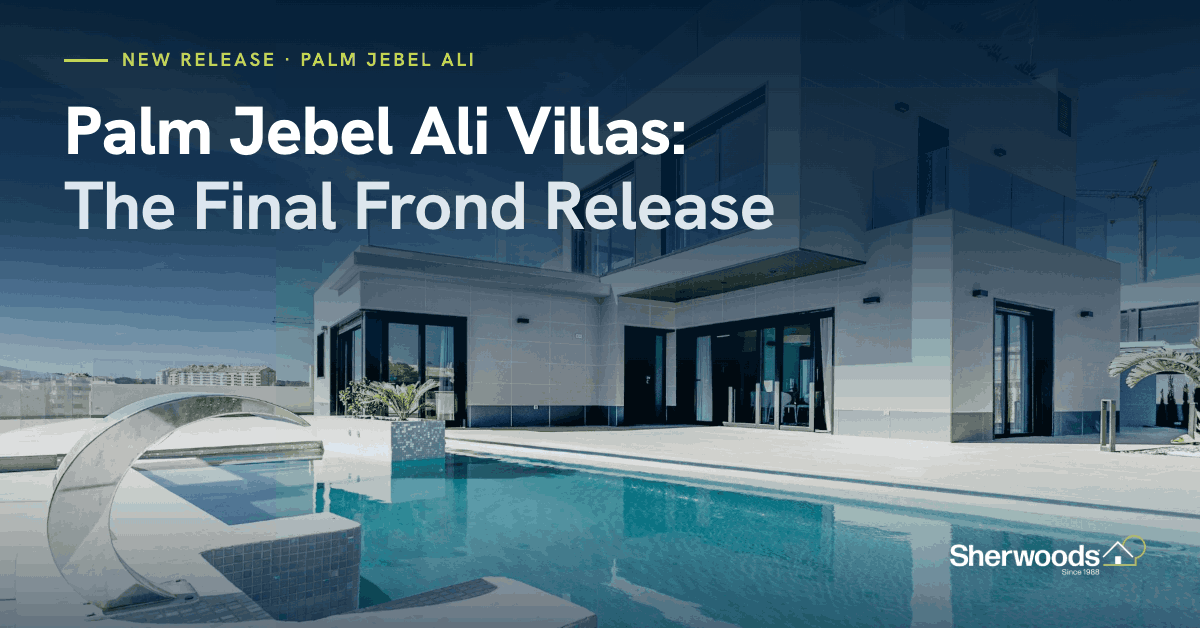
Frond G is the final frond release at Palm Jebel Ali. Every previous frond has sold out, and no further frond launches are planned. The release comprises Beach Villas of five and six bedrooms from around AED 30 million and Coral Villas of six and seven bedrooms from around AED 50 million, all with direct beachfront access. After this, the only route onto a Palm Jebel Ali frond is the secondary market.
Almost everything written about Palm Jebel Ali villas describes the lifestyle. Very little of it tells you what actually separates a plot that performs from one that disappoints, and on a palm-shaped island those differences are unusually large. When it is also the last release, getting the plot right stops being a preference and becomes the whole decision.
Sherwoods has been selling Dubai property since 1988. We sold on Palm Jumeirah from its early phases and watched which plots appreciated and which did not. What follows applies that experience to Palm Jebel Ali.
Prices below are indicative starting points published ahead of release and are confirmed at launch. Treat them as a guide to the tier, not as a quote.
The Fronds at Palm Jebel Ali: what is releasing
| Product | Bedrooms | Indicative starting price | Key feature |
|---|---|---|---|
| Beach Villas | 5 and 6 | From approximately AED 30 million | Direct beachfront access |
| Coral Villas | 6 and 7 | From approximately AED 50 million | Larger plots, greater privacy |
The Fronds district is positioned as the understated ultra-luxury tier of the masterplan: a contemporary villa collection with direct beach access, sea views and a deliberate emphasis on privacy over spectacle.
The gap between the two products is substantial, and it is not simply an extra bedroom. It reflects plot size, water frontage and position. Anyone treating the Coral Villa as a Beach Villa with more space has misread the pricing.
Why frond position decides your outcome
This is the section that matters most, and it is almost never written.
On a palm-shaped island, two villas of identical specification can differ enormously in value based purely on where they sit. Four variables drive it.
Orientation
Each frond has villas on both flanks, facing the water channel between fronds. One flank faces broadly east, the other broadly west.
West-facing plots capture sunset over the Gulf. East-facing plots get morning light and cooler afternoon terraces. In Dubai’s climate, that afternoon shade is a genuine liveability difference rather than a preference, and it consistently commands a premium on Palm Jumeirah.
Decide which you want before you look at availability, because you will otherwise be talked into whichever is available.
Position along the frond
Plots near the tip typically offer wider water outlook, more privacy and a stronger sense of seclusion. Plots near the base sit closer to the trunk, the road network and the amenity spine, which means shorter journeys and easier access.
Tip plots generally price higher. Whether that premium is worth paying depends on whether you will actually live there or let it. Tenants tend to value convenience more than owners do.
The outlook across the channel
Every frond villa looks across water at another frond. What sits opposite, how far away it is, and how densely it is built determines whether your view feels private or overlooked.
This is checkable on the masterplan before you buy and it is the single most common thing buyers fail to check.
Which frond
Fronds differ in length, in proximity to the trunk and to entry points, and in what the wider masterplan places nearby. Nakheel’s most recent release was Frond F, and every previously launched frond is now sold out. This launch moves to Frond G. Confirm the specific frond and plot number in your reservation documentation rather than relying on marketing renders.
The practical rule: on Palm Jumeirah, the spread between the best and worst positioned villas of comparable size has been very wide. There is no reason to expect Palm Jebel Ali to behave differently. Position is not a detail here. It is most of the investment decision.
What it means that this is the last frond
Nakheel has released Palm Jebel Ali’s fronds in sequence, and every one launched so far has sold out. Frond F was the most recent. Frond G is the final release, and no further frond launches are planned.
That changes the calculation in ways worth setting out properly, including the ways it does not.
Developer supply ends here
Sequential launches step up in price, and this is the top of that sequence. You are buying at the highest entry point Nakheel has set, not the lowest. Anyone framing a final release as a bargain is selling rather than advising.
What you are paying for instead is a fixed denominator. Once Frond G is allocated, the total quantity of frond villas at Palm Jebel Ali is set permanently. Every future buyer who wants one has to persuade an existing owner to sell.
That is a genuinely different supply structure from a masterplan with phases still to come, and it is the substantive argument for buying now. Ask what Frond F released at and what it trades at on the secondary market today. That comparison, not a brochure projection, tells you whether current pricing is reasonable.
There is no cheaper back door either. Earlier fronds are sold out, and their owners price against current launch values rather than against what they originally paid.
A complete sell-out record is the signal that matters
A developer that keeps bringing phases to market is a developer funding construction. A developer whose every phase sells out is a developer with genuine demand behind it. Those are different things, and only the second one is hard to manufacture.
Given this project’s history, a complete absorption record across all launched fronds is the most meaningful evidence available that the relaunched masterplan is progressing rather than stalling. Marketing can generate a launch. It cannot generate a sell-out across consecutive phases.
Watch for the opposite as well. A frond that lingers unsold, or a long pause between releases, would be worth asking questions about.
The last buyer takes the least risk
There is a genuine advantage to buying last that rarely gets acknowledged. A buyer on Frond A committed to an empty island on a project that had stalled once before. A buyer on Frond G is buying into a masterplan that is fully allocated, under construction and heading toward delivery.
You pay more for that certainty, and that is the honest trade. Early buyers took project risk and were compensated with a lower entry price. You are taking less project risk and paying accordingly.
Which is better depends entirely on your position. Buyers chasing maximum upside wanted to be early and no longer can be. Buyers who wanted to see the masterplan take shape before committing capital have been waiting for exactly this moment, and this is the last one available.
What a final release does not mean
Three things worth being clear about, because scarcity arguments get overstated.
It does not remove timeline risk. Palm Jebel Ali still has years of construction and infrastructure delivery ahead. A fixed supply of villas on an island that is not yet finished is still a long-horizon commitment.
It does not mean supply never grows. Developer supply ends. Secondary supply does the opposite: as earlier fronds deliver, some owners will sell, and resale inventory will increase from close to zero. Scarcity is real at the developer level and looser at the market level.
It does not guarantee appreciation. Constrained supply supports value when demand holds. If demand for ultra-prime Dubai beachfront softens, a fixed supply falls in price just as a growing one would. Scarcity is a support, not a floor.
The accurate framing is that this is your last opportunity to buy from the developer, at developer pricing, with developer payment terms. That is meaningful. It is not the same as a guaranteed return.
The resale question for earlier buyers
If you already own on an earlier frond, the Frond G launch is directly relevant to you. New-phase launch pricing sets the reference point that resale buyers will compare your unit against, and a higher launch price for G supports your valuation directly.
There is a second effect worth understanding. With earlier fronds sold out, buyers who want those specific positions have to come to the secondary market, and you are one of a finite number of sellers. That is a meaningfully stronger position than owning in a phase where the developer still holds stock. The constraint is that G introduces fresh developer inventory competing for the same buyer, which affects timing rather than price.
Palm Jebel Ali compared with Palm Jumeirah
This is the comparison every prospective buyer is running, so here it is directly.
Palm Jumeirah is a finished, proven asset. The infrastructure exists, the restaurants and hotels operate, the rental market is established and there is more than a decade of transaction evidence. You can see exactly what you are buying and price it against comparables. What you cannot do is buy it cheaply.
Palm Jebel Ali is a larger, earlier-stage development. It is materially bigger than Palm Jumeirah, which changes the character of the island. More coastline, more space between properties, less density. What it does not yet have is delivered infrastructure, an operating hospitality scene or a rental track record.
The location difference is real. Palm Jumeirah sits beside Dubai Marina and JBR, minutes from established districts. Palm Jebel Ali sits further along the coast toward the southern growth corridor. That currently means a longer journey to central Dubai, and prospectively means proximity to where the city’s expansion, including Al Maktoum International Airport, is heading.
The trade in one line: Palm Jumeirah is a stabilised asset you buy at a known price. Palm Jebel Ali is an early-stage position on Dubai’s westward growth. Neither is objectively better. They suit different buyers with different time horizons and different tolerance for uncertainty.
The history, and why it matters
Anyone researching this project will find the history, so it is better addressed openly than discovered later.
Palm Jebel Ali was originally announced in the early 2000s. Construction on the reclaimed land progressed before the 2008 financial crisis, after which the project was shelved for over a decade. Nakheel relaunched the masterplan in 2023 with a substantially revised design.
That history invites an obvious question, and it deserves a straight answer rather than a deflection.
What is different now is the surrounding context. The land reclamation from the original phase already exists rather than needing to be created. Dubai’s population and the southern corridor have grown substantially. Nakheel now sits within a consolidated government-linked development structure with considerably more balance sheet depth behind it than in 2008. And the earlier phases of the relaunched masterplan have sold, which gives the developer both capital and commitment.
None of that is a guarantee. It does mean the 2023 relaunch starts from a materially different position than the 2002 original.
The honest framing for a buyer is this: Palm Jebel Ali is a long-horizon commitment on a masterplan that will take years to mature. That is the actual risk, and it is a timeline risk rather than a solvency one. If your holding period is shorter than the delivery schedule, this is the wrong purchase regardless of how attractive the villa is.
Beach Villa or Coral Villa
The AED 20 million gap between the two starting points is the decision most buyers agonise over. A framework:
Choose the Beach Villa if the sixth bedroom is genuinely surplus to your needs, you want the lowest entry point into The Fronds, or you are buying primarily as an asset rather than a residence. The lower price tier will have a broader resale pool.
Choose the Coral Villa if you are buying to live in, you want the larger plot and the additional separation from neighbours, or you are specifically targeting the ultra-prime tenant and buyer segment where scarcity matters more than price.
The resale consideration: at the top of any market, the buyer pool thins. A seven bedroom villa at AED 50 million-plus has fewer potential purchasers than a five bedroom at AED 30 million. That is not an argument against it, but it should inform your expected time to sell.
Who this suits, and who it does not
A good fit for:
- Buyers with a genuine ten-year-plus horizon who want an early position in a masterplan
- End users who want beachfront space that Palm Jumeirah can no longer offer at any comparable price per square foot
- Buyers seeking a UAE Golden Visa alongside a lifestyle asset
- Portfolio buyers diversifying across Dubai’s coastline
A poor fit for:
- Anyone needing rental income in the near term. There is no rental market until delivery
- Buyers who need liquidity. Off-plan ultra-prime is the slowest segment to exit
- Anyone uncomfortable holding through a long construction period
- Buyers who have not stress-tested the payment plan against their own cash flow
Preparing for the release
Releases in this tier are allocated quickly, and the best-positioned plots go first. What separates a good outcome from a mediocre one is preparation, not speed on the day.
- Decide orientation, frond position and villa type in advance, and rank three alternatives
- Register with a broker holding allocation before the release rather than after
- Have passport, Emirates ID where applicable, and proof of funds ready
- Confirm the payment plan structure and model it against your own liquidity
- Ask for the plot-specific masterplan showing what sits opposite your villa
- Confirm the plot number and frond in writing at reservation
Buyers who begin the conversation on release day are choosing from what is left. That is the entire mechanic of a launch like this.
Frequently asked questions
What is the starting price for Palm Jebel Ali villas?
Beach Villas of five and six bedrooms are expected to start from approximately AED 30 million, and Coral Villas of six and seven bedrooms from approximately AED 50 million. Final pricing is confirmed at release and varies by plot, frond and orientation.
Who is the developer of Palm Jebel Ali?
Nakheel, the master developer behind Palm Jumeirah, now operating within Dubai’s consolidated government-linked development structure.
Can foreigners buy Palm Jebel Ali villas?
Yes. Palm Jebel Ali is a designated freehold area, so non-UAE nationals can own property there outright.
How big is Palm Jebel Ali compared with Palm Jumeirah?
Palm Jebel Ali is considerably larger than Palm Jumeirah, with more coastline and lower density across the masterplan.
What is the difference between Beach Villas and Coral Villas?
Beach Villas offer five and six bedroom configurations at the lower entry point. Coral Villas offer six and seven bedrooms on larger plots with greater privacy and more water frontage, at a materially higher price.
Do Palm Jebel Ali villas qualify for a Golden Visa?
Property purchases at or above the qualifying threshold can support a Golden Visa application, subject to current criteria and the structure of the purchase. Villas in this price tier comfortably exceed the threshold.
Which frond is Nakheel launching next at Palm Jebel Ali?
Frond F was the most recent release. The current launch is Frond G, comprising Beach Villas and Coral Villas in The Fronds district.
Are earlier Palm Jebel Ali fronds still available?
No. Every frond launched before Frond G has sold out. The only route into an earlier frond is through the secondary market, where pricing is set against current launch values rather than original purchase prices.
Is Frond G the last release at Palm Jebel Ali?
Yes. Frond G is the final frond release, and no further frond launches are planned. Once it is allocated, the total number of frond villas at Palm Jebel Ali is fixed, and future buyers will need to purchase from existing owners.
Which frond is best at Palm Jebel Ali?
There is no single best frond. What matters is orientation, position along the frond, what sits opposite across the water channel, and proximity to the trunk. These factors typically create a wider value spread than the villa specification itself.
Is Palm Jebel Ali a good investment?
It suits buyers with long horizons who want an early position in a large masterplan on Dubai’s westward growth corridor. It is unsuitable for anyone needing near-term rental income or liquidity, since delivery and market maturity will take years.
Get the right plot on the last frond
The villa specification is published and identical across dozens of units. The plot is not. Orientation, position along the frond and what sits across the water are where the value difference lives, and they are decided in the first hours of a release.
With no further frond launches planned, there is no next release to correct a rushed decision.
Sherwoods has been advising Dubai buyers since 1988, including through the launch and maturity of Palm Jumeirah. We will tell you which positions are worth paying a premium for at Palm Jebel Ali, which are not, and when the honest answer is that a different asset suits you better.
- UAE: +971 4 355 0094 or +971 50 591 5762
- UK: +44 20 3962 9980
- Email: info@sherwoodsproperty.com
- Web: sherwoodsproperty.com
Tell us your budget, whether you are buying to live in or to hold, and your preferred orientation. We will come back with the plots worth your attention before they are gone.
Sherwoods Property, since 1988.
Pricing shown is indicative and published ahead of release. Final prices, plot availability, payment plans and handover schedules are confirmed by the developer at launch and are subject to change. All project details should be verified in your reservation documentation. Sherwoods International Property, RERA registration number 1238.
