
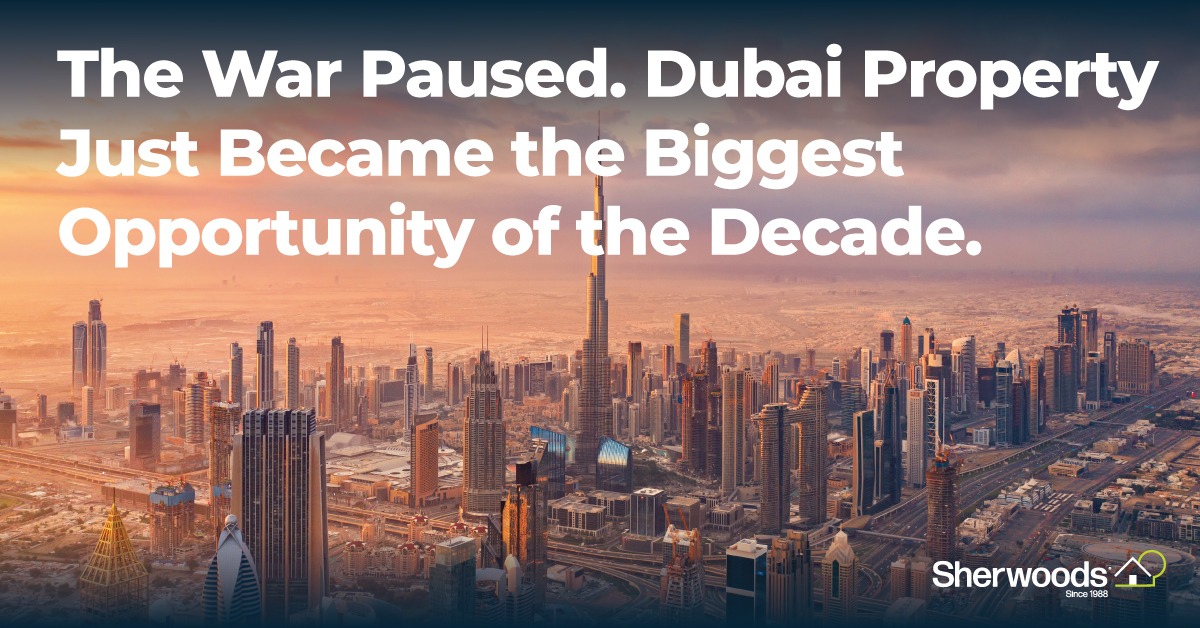
It happened, President Donald Trump announced a two-week ceasefire with Iran brokered by Pakistan ending over five weeks of one of the most disruptive geopolitical conflicts the Middle East has seen in a generation. The Strait of Hormuz is reopening. Oil prices have already plunged over 13%. Global markets are rallying. And Dubai’s real estate market which has been sitting on a coiled spring of pent-up demand is about to release.
If you’ve been watching the headlines and wondering whether now is the right moment to move on Dubai property, this is the blog you need to read. We’re going to tell you exactly what happened, what it means for the market, and based on 38+ years of experience navigating every regional crisis why the window you’re looking at right now is the one investors will talk about for years.
Table of Contents
- What Just Happened: The Ceasefire Explained
- How the Iran War Actually Impacted Dubai Property
- What the Ceasefire Means for Dubai Real Estate
- History Proves It: Dubai Always Comes Back Stronger
- The Numbers: Demand Is Already Returning
- Where to Invest in Dubai After the Ceasefire
- Investor FAQs: Your Ceasefire Questions Answered
- How Sherwoods Can Help You Act Now
What Just Happened: The Ceasefire Explained
On the evening of April 7, 2026, President Trump announced a two-week ceasefire with Iran brokered through direct negotiations facilitated by Pakistani Prime Minister Shehbaz Sharif. The deal came less than two hours before a Trump-imposed deadline that threatened large-scale strikes on Iranian infrastructure, including power plants, bridges, and petrochemical hubs.
The key terms are significant:
- Iran has agreed to reopen the Strait of Hormuz — the critical maritime corridor through which roughly one-fifth of the world’s oil supply flows, which had been effectively closed since the war began in late February.
- Both the US and Iran have agreed to a two-week pause in military strikes, with peace talks set to begin in Islamabad, Pakistan, on April 10th.
- Iran submitted a 10-point peace proposal which Trump described as a “workable basis on which to negotiate,” with most major points of contention reportedly close to resolution.
- Israel has also agreed to the ceasefire, according to White House officials, though questions remain about Lebanon.
Markets reacted immediately. S&P 500 futures rose more than 1%. Oil futures dropped approximately 6% within minutes of the announcement. The global sigh of relief was instantaneous and for Dubai real estate investors, the implications are enormous.
“This will be a double-sided CEASEFIRE! We are very far along with a definitive Agreement concerning Long-term PEACE with Iran, and PEACE in the Middle East.” — President Donald Trump, Truth Social, April 7, 2026
How the Iran War Actually Impacted Dubai Property — The Truth Behind the Headlines
Before we look forward, let’s be precise about what the conflict actually did to Dubai’s property market because the headlines have wildly overstated the damage, and that misinformation is costing investors money.
What Did Happen
When US and Israeli forces launched coordinated strikes on Iran in late February 2026, killing Supreme Leader Ali Khamenei, Iran retaliated with a wave of over 1,130 missile and drone attacks across the Gulf. Some of this debris affected Dubai — drone debris hit near Dubai International Airport, grazed the Burj Al Arab, and landed on Palm Jumeirah. The Dubai Financial Market (DFM) closed for two consecutive sessions — an almost unprecedented event and the DFM Real Estate Index dropped approximately 20-21%, wiping out all of 2026’s equity gains.
New buyer inquiries dropped around 45%. Transaction signings were delayed. International buyers — especially those unfamiliar with the region paused and adopted a wait-and-see approach.
What Didn’t Happen
Property prices did not crash 20-40%. The DFM index measures developer equities listed stocks not physical property values. Actual completed property prices fell just 4–7% from peak — a modest correction in a market that had surged for five consecutive years. No major real estate asset sustained structural damage. Developers like Emaar did not drop their prices. And critically, the transactions that were still flowing even during the worst weeks of the conflict — showed the market’s extraordinary resilience.
Between March 23–29 alone, Dubai recorded AED 8.66 billion in ex-land property transactions a 49% increase week-on-week. The market was not dying. It was pausing. And now the pause is over.
What the Ceasefire Means for Dubai Real Estate: The Four Forces That Drive Recovery
The declaration of a ceasefire — even a temporary two-week one — triggers a powerful cascade of effects across Dubai’s property market. Here are the four forces that will drive the recovery:
1. The Return of Buyer Confidence
The single biggest suppressor of Dubai property transactions over the past six weeks has not been price — it has been sentiment. International buyers from Europe, India, Asia, and the UK were not refusing to buy because Dubai property was overpriced. They were waiting for clarity. That clarity has now arrived. The moment ceasefire is declared, the psychological brake is released. Delayed buyers return to the table. Site visits — which had already surged 75% during the conflict as savvy investors prepared — convert into signed deals.
2. The Pent-Up Demand Surge
Every week of delayed transactions represents accumulated buying intent that doesn’t disappear — it waits. The Arab Spring, the 2008 financial crash, the 2020 pandemic in every single regional crisis, Dubai’s market experienced a period of suppressed transactions followed by a sharp surge as confidence returned. That demand was real before the conflict began; Dubai recorded AED 917 billion in property transactions in 2025 — the highest in the emirate’s history. That structural demand hasn’t evaporated. It’s queued.
3. The Flight of Capital Toward Dubai
Every major regional crisis in the past two decades has ultimately redirected global capital into Dubai, not away from it. The Arab Spring brought wealth from Egypt, Syria, and Libya. The Russia-Ukraine war in 2022 triggered a luxury property boom driven by Russian HNWIs. This conflict — which has devastated Iranian infrastructure and deeply unsettled Lebanon — will once again make Dubai the region’s most obvious destination for displaced wealth. Investors from conflict-affected markets don’t stop investing. They invest somewhere safer. Dubai is that destination.
4. The Strait of Hormuz Reopening = Oil Revenue Stability = Gulf Confidence
One of the least-discussed consequences of the Hormuz closure has been its knock-on effect on Gulf sovereign wealth and government spending confidence. With the strait effectively closed since late February — reducing vessel traffic by 94% — Gulf states faced oil revenue pressure that dampened their willingness to deploy capital into regional development projects. That constraint is now lifted. Oil prices falling 13% on ceasefire news means stable, predictable energy flows return — and with them, the confidence that underpins large-scale infrastructure investment in Dubai and the UAE.
History Proves It: Dubai Has Bounced Back From Every Regional Crisis — and Always Stronger
Let’s put the current situation in context, because context is everything when making a property investment decision.
| Crisis | Year | Short-Term Impact on Dubai | 12-Month Recovery |
|---|---|---|---|
| Gulf War I | 1990–91 | Significant sentiment shock | Full recovery + new investment inflows |
| 9/11 Attacks | 2001 | Tourism and investment pause | Dubai construction boom begins |
| Global Financial Crisis | 2008–09 | Property prices fell 40–50% | Recovery began 2011–12; record highs by 2014 |
| Arab Spring | 2011 | Regional capital flight | Capital flooded INTO Dubai |
| COVID-19 Pandemic | 2020 | Transactions fell sharply Q2 2020 | Record-breaking 2021–2025 boom followed |
| Russia-Ukraine War | 2022 | Minimal direct impact on Dubai | Luxury prices surged on Russian HNW inflows |
| US-Iran War / Ceasefire | 2026 | 4–7% price dip; transaction pause | Analysts forecast 5–8% recovery by year-end |
The pattern is consistent and undeniable. Dubai property has never permanently declined as a result of a regional geopolitical event. It has paused. It has corrected modestly. And then it has surged driven by exactly the kind of global capital that was waiting on the sidelines for clarity.
The investors who move during the uncertainty consistently outperform those who wait for the headlines to clear.
The Numbers: What the Data Already Tells Us About Returning Demand
The recovery didn’t wait for the ceasefire announcement — the data was already showing green shoots throughout March and early April 2026:
- AED 176.7 billion in total property sales in Q1 2026 — a 23.4% year-on-year increase — despite the conflict beginning mid-quarter.
- January 2026 recorded AED 72.4 billion in residential sales the single highest month in Dubai real estate history.
- Property viewing activity surged 75% in the final days of March as investors began preparing to move.
- Off-plan sales accounted for 69–77% of total transaction value throughout the conflict period — reflecting buyers betting on Dubai’s medium-to-long-term future.
- The median price per square foot stood at AED 1,759 as of Q1 2026 — a 12.5% year-on-year increase, even accounting for the war period.
- Rental market resilience: Over 139,000 rental transactions were recorded in Q1 2026, driven by continued population growth and stable tenant inflows.
With the ceasefire now declared, institutional analysts had already forecast that a comprehensive peace agreement would return prices to pre-crisis levels within 3–6 months, with the DFM Real Estate Index recovering above 15,000 — driven by pent-up demand re-entering the market simultaneously.
That scenario has now begun.
Where to Invest in Dubai After the Ceasefire: The Areas and Asset Classes Set to Lead the Recovery
Not all Dubai property will recover at the same speed. Here’s where Sherwoods’ 38+ years of market experience tells us the strongest post-ceasefire value lies:
Prime Waterfront — Palm Jumeirah, Dubai Marina, Jumeirah Bay
These are the areas where cash buyers dominate, leverage is lowest, and the premium is supported by genuinely limited future supply. They fell least during the conflict and will recover fastest. Knight Frank projected a 3% rise in the prime segment in 2026 even before factoring in ceasefire recovery momentum.
Downtown Dubai and Business Bay
The city’s commercial and lifestyle core. Rental demand from the professional and corporate community that stayed in Dubai throughout the conflict makes this segment particularly well-supported. Commercial real estate in Q1 2026 recorded a 69.2% year-on-year surge in value a signal of institutional confidence that didn’t go away during the war.
Dubai Hills Estate and Emerging Southern Corridors
For investors with a 3–5 year horizon, the growth corridors south of the city including Dubai Hills, Al Barsha South Fourth, and newer master-planned communities offer the strongest capital appreciation upside as the city’s population, forecast to add 225,000 new residents in 2026 alone, continues to expand.
Off-Plan with Flexible Payment Plans
This is the insight most investors miss: the crisis created payment plan flexibility from developers that simply didn’t exist before. Developers who would previously demand 40–50% upfront are now offering extended payment structures to maintain velocity. These terms are temporary. When confidence fully returns, they disappear. Locking in an off-plan purchase today with war-era payment flexibility and pre-peace price levels is one of the clearest risk-adjusted opportunities in the current market.
Branded Residences
Bugatti, Armani, Four Seasons, Aman — Dubai’s branded residence sector kept its premium throughout the conflict because ultra-high-net-worth demand is the least price-sensitive and most internationally mobile. Post-ceasefire, expect renewed activity from wealth relocating out of Iran and Lebanon.
Investor FAQs: Your Ceasefire and Dubai Property Questions Answered
Is the ceasefire permanent?
The current agreement is a two-week pause, with peace talks beginning in Islamabad on April 10th. Both sides have indicated the framework for a longer-term agreement is largely in place. For property investors, even a sustained two-week pause — and the trajectory toward permanent peace is sufficient to unlock the pent-up demand that has been building since late February.
Should I wait until a permanent peace deal before buying?
History answers this clearly: no. The biggest price gains have always been captured by investors who moved during the uncertainty, not after it resolved. By the time a permanent deal is signed and celebrated in the media, prices will have already moved. The window is now — not then.
What about the risk of the ceasefire collapsing?
It’s a legitimate risk and worth acknowledging. Both sides retain military readiness. However, the structural damage to Dubai property in a scenario of renewed conflict would likely mirror what we’ve already seen a temporary correction of 4–7% in physical prices — not a structural collapse. If you are investing with a 3–5 year horizon, the probability-weighted outcome strongly favours buying now.
Have Dubai property prices already bounced back?
Physical property prices fell approximately 4–7% from their February 2026 peak. As of today, that correction is intact — meaning you are still buying at a modest discount to the pre-war high, before the full recovery demand enters the market. This window is time-sensitive.
What rental yields can I expect in Dubai right now?
Dubai continues to offer gross rental yields of 6–9% across residential assets, depending on community and asset class — substantially above London (2.8%), Singapore (3.5%), and Hong Kong (2.2%). Combined with zero income tax and zero capital gains tax, the net return case for Dubai remains among the strongest of any major global city.
Who can own property in Dubai?
Foreign nationals can own freehold property in designated areas — including most of Dubai’s prime districts. There is no annual property tax. A one-time 4% Dubai Land Department transfer fee applies. Golden Visa residency is available for property purchases of AED 2 million or more, offering a 10-year renewable UAE residence visa.
How Sherwoods Property Can Help You Act Now — Before the Market Fully Recovers
At Sherwoods, we’ve been operating in the UAE and UK since 1986. We’ve guided clients through every regional crisis the Gulf has faced — the Gulf War, 9/11, the 2008 crash, the Arab Spring, COVID-19. And in every single case, the investors who acted with us during the uncertainty came out materially ahead of those who waited.
We know this market better than anyone. And right now, we’re seeing the specific opportunities that the conflict has created — below-market listings from motivated sellers, developer payment plan flexibility that won’t survive a full recovery, and a price level that is genuinely below replacement cost for completed stock.
These opportunities exist today. They will not exist in three months.
Here’s what we can do for you right now:
- ✅ Free investment consultation — we’ll assess your budget, goals and timeline and identify the specific properties where the post-ceasefire upside is strongest
- ✅ Below-market deal sourcing — our network surfaces motivated sellers and distress deals that are not publicly listed
- ✅ Off-plan advisory — we’ll identify which developers are offering the best war-era payment flexibility before those terms disappear
- ✅ Golden Visa guidance — we help international buyers structure purchases to qualify for UAE residency
- ✅ Full transaction management — from initial offer to title deed, we manage the entire process
📞 Book Your Free Consultation with Sherwoods Today
The Bottom Line: The Ceasefire Has Started the Clock
The US-Iran ceasefire announced on April 7, 2026 is not the end of a story it is the beginning of one. The six weeks of conflict created exactly what every experienced property investor dreams of: a genuine, temporary, geopolitically-driven pricing dip in one of the world’s most fundamentally sound real estate markets.
Dubai’s structural story hasn’t changed. Zero property tax. 6–9% rental yields. 225,000 new residents arriving every year. AED 917 billion in transactions in 2025. A government that has proven, time and again, that it will do whatever it takes to protect the emirate’s position as the world’s most investable city.
What has changed very briefly is sentiment. And sentiment, in property, is the gap between price and value. That gap is open right now. It won’t be open for long.
The investors who look back on this moment in two years will remember it as the clearest buying opportunity of the decade. Don’t be the person who remembers it as the moment they hesitated.
Sherwoods is ready. The question is: are you?
Get in Touch with Our Investment Experts →
About Sherwoods Property: Founded in 1986, Sherwoods is one of the UAE’s most established independent real estate agencies, with 38+ years of experience across Dubai, Abu Dhabi, and the UK. Our team has guided thousands of investors through every market cycle the region has seen. Visit us at sherwoodsproperty.com or call our Dubai office to speak directly with a senior investment advisor.
