
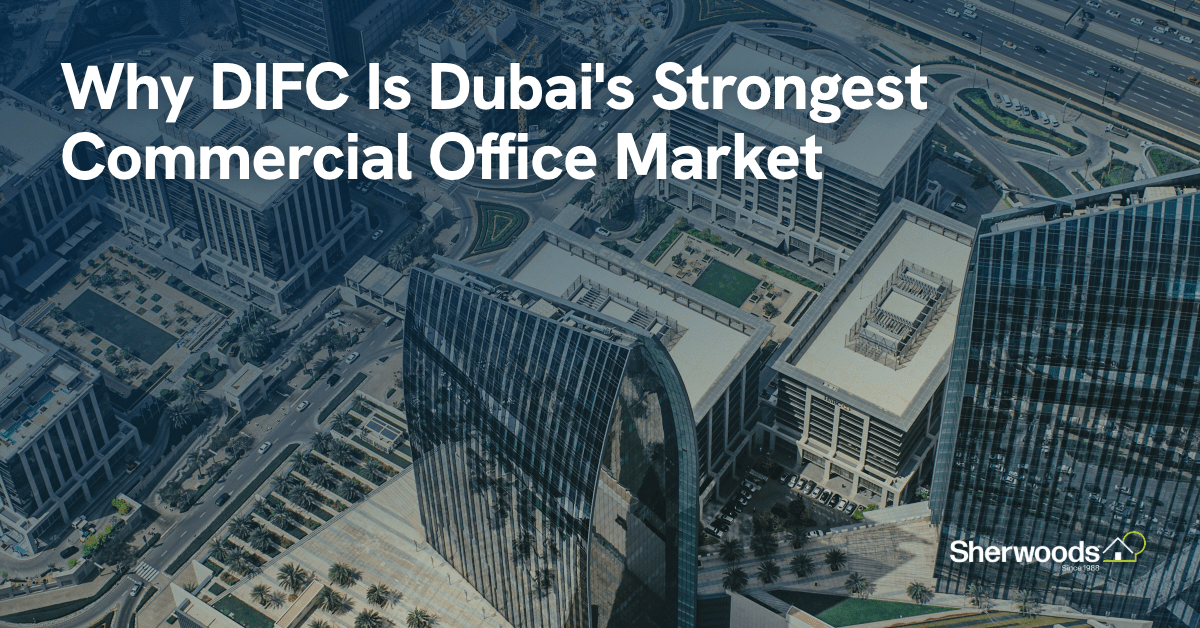
DIFC is Dubai’s strongest commercial office market because its tenant demand is structurally captive. Firms regulated by the Dubai Financial Services Authority are required to maintain premises inside the DIFC, so a licence to operate is also a commitment to lease there. Combine that with constrained supply, English common law property title registered with the DIFC Registrar of Real Property, and the deepest resale liquidity of any Dubai office district, and DIFC offers the market’s lowest income risk. Investors accept a lower gross yield in exchange for tenant covenant strength, rent durability and a reliable exit.
That is the case in short. Below is the detail, including who DIFC is not right for.
What is DIFC?
The Dubai International Financial Centre is a financial free zone established in 2004, occupying a defined district between Sheikh Zayed Road and Al Mustaqbal Street in central Dubai.
It is not simply a business park with tax incentives. DIFC operates:
- Its own civil and commercial legal system based on English common law, separate from UAE federal civil law
- The DIFC Courts, an independent English language common law judiciary
- The Dubai Financial Services Authority (DFSA), an independent financial regulator
- Its own real property register, maintained by the DIFC Registrar of Real Property
Occupiers include international and regional banks, asset managers, hedge funds, family offices, insurers, reinsurers, global law firms, and fintech companies based in the DIFC Innovation Hub.
Key buildings include Gate Village, Gate Avenue, Index Tower, Currency House, Burj Daman, Liberty House, Emirates Financial Towers, Central Park Towers, Park Towers and ICD Brookfield Place.
Why is demand for DIFC offices structurally different?
This is the argument that most DIFC marketing never makes, and it is the strongest one available.
A firm authorised by the DFSA must maintain a physical place of business within the DIFC. Its regulatory permission is tied to the jurisdiction. For a licensed bank, asset manager, insurer or advisory firm, leaving DIFC is not a cost saving decision, it is a re-licensing project involving a new regulator, new approvals and client disclosure.
Three consequences follow, and each one matters to a landlord:
- Relocation resistance. A cheaper office in Business Bay is not a substitute product for a DFSA regulated tenant. It is not in the same market.
- Rent inelasticity. Tenants who cannot relocate absorb rent increases further than tenants who can. That supports both renewal rates and reversionary rent growth.
- Covenant quality. Regulated financial institutions are capitalised, audited and supervised. As lease counterparties they are among the strongest available anywhere in the UAE.
Every other Dubai office district competes on price, specification and location. DIFC competes on a regulatory requirement. That is a moat, not a marketing claim.
What does the legal jurisdiction mean for a property investor?
DIFC real estate is freehold and available to buyers of any nationality, but the ownership mechanics differ from mainland Dubai in ways buyers routinely underestimate.
| Feature | Mainland Dubai | DIFC |
|---|---|---|
| Registering authority | Dubai Land Department | DIFC Registrar of Real Property |
| Governing property law | UAE and Dubai property legislation | DIFC Real Property Law, common law based |
| Dispute forum | Dubai Courts, Rental Dispute Centre | DIFC Courts |
| Leases and registration | Ejari | DIFC leasing and registration regime |
| Governing language | Arabic | English |
For international investors and institutional buyers, this is a feature rather than a complication. Title, security interests, mortgages and landlord remedies sit within a common law framework, in English, before a judiciary staffed by common law judges. That familiarity is a large part of why cross-border capital is comfortable in DIFC.
Practically, it also means your conveyancing process, fees and timelines differ from a mainland transaction. Use advisers who transact in DIFC specifically.
Why does constrained supply matter so much here?
DIFC is a bounded district. It cannot expand outwards, only upwards and through phased development such as the DIFC 2.0 expansion.
Meanwhile demand has been driven by a well documented influx of asset managers, hedge funds and family offices establishing regional presence in Dubai. The result reported consistently by the major agencies has been very high occupancy across prime DIFC stock and sustained upward pressure on prime office rents.
For an investor the mechanism is simple. Where supply cannot readily respond to demand, rent growth accrues to the landlord rather than being competed away by new completions.
Which DIFC buildings can an individual investor actually buy?
A practical point that general market commentary omits.
Not all DIFC office stock is available for purchase. Several of the highest specification assets are held by single institutional owners and leased only, never sold floor by floor. Investor accessible stock is concentrated in strata titled towers, where individual floors and units are separately owned.
Consequently the buyable universe in DIFC is narrower than the visible skyline suggests, and it varies by unit size. Before setting a budget, establish which buildings actually trade, at what floor sizes, and in what condition. Fitted floors and shell and core floors are very different propositions once you price a Grade A fit out.
What are the risks and drawbacks of DIFC office investment?
A district described as best without qualification should be distrusted. These are the genuine counterpoints.
| Risk | What it means in practice |
|---|---|
| Highest entry price in Dubai | The largest capital outlay per square foot of any office district, which raises the absolute cost of any mistake |
| Compressed gross yield | You are buying covenant strength and liquidity, so income return is lower than secondary districts such as JLT, Barsha Heights or Motor City |
| High service charges | Grade A specification, district cooling and premium common areas carry service charges that materially separate gross from net yield |
| Expensive fit out expectations | Tenants expect Grade A finish. Shell and core floors need serious capital before they are lettable at headline rents |
| Sector concentration | Income is tied to financial and professional services. A sustained downturn in that sector affects the whole district at once |
| Tax regime is evolving | The UAE corporate tax regime and the qualifying free zone person rules affect occupier economics. Take current professional tax advice rather than relying on historic zero tax messaging |
| Limited buyable stock | Strata availability constrains choice, and the best floors trade infrequently |
Note the honest tension: DIFC delivers the lowest income risk and the lowest income yield at the same time. Both statements are true, and they are the same fact viewed from two directions.
So is DIFC right for you?
DIFC suits investors who want:
- Institutional grade tenant covenants and long leases
- Capital preservation and rent durability ahead of headline yield
- A common law title and English language documentation
- A liquid exit, including to international and institutional buyers
- Central location with metro access and a mature amenity base
DIFC is the wrong choice for investors who want:
- The highest available gross yield
- A low absolute capital commitment
- Exposure to broad SME tenant demand rather than financial services
Both are legitimate strategies. They are simply different products, and an adviser who recommends the same district to every buyer is not advising.
Frequently asked questions
Can foreigners buy office space in DIFC?
Yes. DIFC property is freehold and available to buyers of any nationality, with title registered at the DIFC Registrar of Real Property rather than the Dubai Land Department.
Is DIFC a free zone?
Yes. DIFC is a financial free zone with its own independent regulator, the Dubai Financial Services Authority, and its own common law legal system and courts.
Why are DIFC office rents the highest in Dubai?
Supply is limited by the district’s fixed footprint while demand is reinforced by regulation, because DFSA authorised firms must maintain premises inside the DIFC. Constrained supply meeting captive demand supports premium rents.
Do DIFC companies pay tax?
The UAE introduced a federal corporate tax regime, under which free zone entities may qualify for a zero percent rate on qualifying income if they meet the qualifying free zone person conditions. Rules and eligibility change, so current professional tax advice is essential.
Does DIFC have metro access?
Yes. The district is served by the Dubai Metro Red Line, with Financial Centre and Emirates Towers stations adjacent to it.
Is DIFC better than Business Bay for office investment?
They serve different objectives. DIFC offers stronger tenant covenants, higher rents and better liquidity at a lower gross yield. Business Bay offers a lower entry price and higher gross yield with a broader, less regulated tenant base and greater competing supply.
Speak to our commercial team
Sherwoods Property has advised buyers, sellers and landlords across Dubai’s commercial market since 1988. If you would like current DIFC availability, verified transaction evidence and a net yield model built around a specific floor, our commercial team can prepare it.
